Showing posts with label supernatural. Show all posts

Saturday, December 01, 2012

MYTHOLOGY: THE PEACOCK MAIDEN (part 1)


Hej (:
How are you guys? I'm fine, and soon I'll be on vacation *-*
I wanted to make a post about the Swan Maidens of Norse mythology, but when I was searching I found this Chinese legend and I found it nice:

 In Monbanja, a land of perennial green, there once lived a king named Bahkeladir. His granaries overflowed with the fruits of good harvests and his palace was beyond compare for splendor and richness, but he had no children. Both he and his queen Machena longed for a son, for an heir to succeed to the throne and complete their happiness.
 And then, one morning in early spring, their wish was fulfilled. The people rushed excitedly about, talking of a strange happening. A man-child crawled out from the foot of a huge white elephant and then disappeared without a trace. Right at this moment, the queen gave birth to a healthy son which the king named Chaushutun, after a prince famous for his bravery, hoping that his son, too, would grow into a strong and brave man.
 With each passing day Chaushutun grew taller and stronger. He diligently studied the arts of peace and war, becoming well versed in the arts and proficient with all weapons. His intelligence was astonishing, and his strength excelled all other men.
One day he peered into a well and by the dim light beheld a strange object in it. The wise old men said that the great King Bahmo had left a wonderful treasure there, which men for many generations had tried in vain to obtain. Chaushutun ordered the well be drained, and when this was done he descended into the well to examine it more closely. The object was a magic bow. So powerful was it that he who owned it could defeat an entire enemy army. No one but Chaushutun had the strength to bend the huge bow. He could draw it taut till it was as round as the full moon, and every arrow from it hit the target clean and sure.
 One day as an evil bird of prodigious size was arrogantly wheeling overhead in the clouds, a black fish clasped in its beak, an arrow from Chaushutun's bow pierced it. The fish fell from its beak into a river, and the bird, mortally wounded, plunged down into the forests below.
Sixteen times the breezes of autumn fanned the paddy fields into a swaying, burning gold. Chaushutun was now a brave, handsome lad, with deep, clear eyes that sparkled with life. His face was more lovely than the legendary Dewawo's, and his voice was like the chiming of bells, soft and musical to the ear.
 When the maidens saw him their mouths and eyes opened wide in admiration and they longed to toss the embroidered pouch of courtship at him, offer him the slit-bamboo stool reserved for their dear ones, and give him love nuts. His parents grew increasingly concerned about his marriage, and time and again urged him to marry a girl of noble birth.
 The treacherous minister Mahashena, eager to increase his influence over the throne, offered his daughter. But it was of no use. Of the many beautiful but empty-headed daughters of nobles, not one could win Chaushutun's heart. His one wish was to find himself a girl as capable as she was beautiful, who could be his faithful companion for life.
 One day, with his magic bow and sword, and mounted on his wonder horse, Chaushutun rode away, over vast fields, over range after range of mountains and through thick forests, to search for a girl after his heart. On the way he fell in with an old hunter named Gohagen and the two became firm friends. Together they hunted the wild boar and the flame-speckled deer, and shared the same fire. As they ate their fill of savory venison they talked of many interesting things. One of the stories Gohagen told the prince was this:
Not many years ago, Bahna, the God of Waters, with a magic weapon captured the son of Bahun, king of all fish-eating birds. In revenge the bird king caught the God of Waters while he was visiting the ocean's surface in the guise of a black fish. And just as the bird king was exulting high in the skies an arrow suddenly struck him, making him release the black fish, which fell down into a river, right into the net old Gohagen had spread. The black fish pleaded to be set free and promised to come to Gohagen's aid whenever he needed help. The kind-hearted Gohagen set the fish free.
 "I admired the bowman whose arrow brought down that fish! I have always hoped that some day I will meet him," concluded Gohagen.
"That unknown bowman probably wants to meet you even more," Chaushutun added with a smile. So they talked through the night, like old, intimate friends.
Chaushutun looked up and sighed. "Ah, bright star!" he said. "Herald of dawn! So high, yet so easily seen. Now why is a beautiful and talented maid born among men so difficult to find?"
 "Love never disappoints pure hearts. The steadfast and true will bring the deep-seated spring water to the surface," Gohagen chuckled knowingly.
Chaushutun nodded. He would remember that saying.
 "And not far from here," the old hunter went on, "is Lake Langsna with its jade-green waters as clear as a polished mirror. And every seven days, seven peacock maidens extraordinarily fair to see bathe there. They are as fair as resplendent flowers, and the youngest outshines them all. When you see her, you will see the beauty of the legendary Nandiowala and you will know what wisdom and cleverness really mean. Come, let us go and see."
 Chaushutun rose eagerly. They mounted their swift horses and soon were at the lake. They hid themselves on the lake's edge and waited.
Source: http://www.pitt.edu/~dash/swan.html#peacock

That's it c:
See you next week
Hej då

Friday, November 23, 2012

BRAZILIAN CULTURE: CORPO SECO


Oh hej
Guess what happened?  No, I didn't forget. This time. I mean, I did, but I wasn't even at home, btw, so whatever. It's my last year of high school and yesterday we had all that beautiful ceremony and all. It was awesome, I've never thought that I would miss that school so much lol. 
Oh well, let's go:

Corpo Seco is a man who spent his life beating and responding to his moder. When he died, he was rejected by God, the Devil and the earth, disgusted, repelled him. One day, he rose from his tomb, completely rotten and completely furious, decided to scare everyone who passed near his favorite road.
In São Paulo, there is a variant of this legend: it is said that when a person passes near the Corpo Seco he jumps and sucks all your blood (like a vampire).
There are also reports of Corpo Seco in the state of Paraná, Amazonas, Minas Gerais, in the Midwest region of Brazil and some African countries of Portuguese language, reported by Brazilian soldiers of the mission UNAVEM III.
In Ituiutaba, Minas Gerais, there is a variation of this legend, which tells that the Corpo Seco - after being repelled by the earth several times - is taken by firefighters to an apparent cave in a mountain range that lies south of the city. They say those who spend the night down the dirt road near to the place, you can hear his screams echoing from inside the cave.
Even today, there is a popular saying: "Whoever hits the mother stays with the withered hand."
Source: Brazilian wikipedia

Aaaaaaand that's it. I won't post anything tomorrow because I have my prom ball today and the ast assay for my flute recital my cousin's birthday party tomorrow and yeah, I think I won't have time. I'll try to post something, anyway.
Hej då

Thursday, November 15, 2012

BRAZILIAN CULTURE: CURUPIRA & CAIPORA

Hej :3
I forgot again lololol oh well, beter late than never, right? 

 Curupira's name comes from the Tupi language kuru'pir, meaning "covered in blisters". According to the cultural legends, this creature has bright red/orange hair, and resembles a man or a dwarf, but its feet are turned backwards. Curupira lives in the forests of Brazil and uses its backward feet to create footprints that lead to its starting point, thus making hunters and travelers confused. Besides that, he can also create illusions and produce a sound that's like a high pitched whistle, in order to scare and drive its victim to madness. It is common to portray a Curupira riding a Collared peccary, much like another Brazilian creature called Caipora.
 A Curupira will prey on poachers and hunters that take more than they need of the forest, and he also attacks people that hunt animals that were taking care of their offspring. There are many different versions of the legend, and so the creature's appearance and habits may vary from each region in Brazil. However, Curupira is considered a nationwide folkloric figure.
 Caipora is an entity of the Tupi-Guarani mythology in Brazil. It is represented as a dark-skinned, small Indian, naked with a very long black mane, smoking a cigar and very mischievous. Other depictions are as a stout hairy anthropomorphic being with the head of a fox. Sometimes it's said that he has his feet turned backwards, to deceive trackers, although this is mostly commonly said of the curupira instead. Some say it rides a great peccary. The Caipora also is said to help the people that are kind to the forest and hurt those who hurt it. It is known as a forest dweller, as a king of the animals of sorts and very vengeful of hunters who do not respect the rules of "fair-play" when hunting. It is told that it scares away prey and "hides" animal tracks or makes hunters lose their way in the jungle.
Source: wikipedia


And that's it :3
sorry again LOL
Hej då

Saturday, October 27, 2012

MYTHOLOGY: RUNES

Hej :3
 More fortune telling-related shit today because it's awesome and I want to learn how to read this so hard. <3 font="font">

 What we now know as the runic alphabet seems to have developed from two distinct sources - one magical, one literate. Pre-runic symbols, or hällristningar, have been found in various Bronze Age rock carvings, primarily in Sweden. Some of these symbols are readily identifiable in the later alphabets, while others represent ideas and concepts which were incorporated into the names of the runes (sun, horse, etc.). The exact meanings of these sigils are now lost to us, as is their original purpose, but they are believed to have been used for divination or lot-casting, and it is fairly certain that they contributed to the magical function of the later runic alphabets.
 There is some debate over the origin of the "alphabet" aspect of the runes. Cases have been made for both Latin and Greek derivation, and several scholars are once again arguing in favor of both these theories. However, the strongest evidence still seems to point to a North Italic origin. The parallels between the two alphabets are too close to be ignored, particularly in the forms of the letters, as well as in the variable direction of the writing, and certain structural and even symbolic characteristics. This would also explain why so many of the runes resemble Roman letters, since both Italic and Latin scripts are derived from the Etruscan alphabet (itself a branch of the Western Greek family of alphabets). This theory would place the original creation of the futhark sometime before the 1st. century, when the Italic scripts were absorbed and replaced by the Latin alphabet. Linguistic and phonetic analysis points to an even earlier inception date, perhaps as far back as 200 B.C..
 When the northern tribes began integrating the Italic alphabets into their own symbolic system, they gave the letters names relating to all aspects of their secular and religious lives, thus transforming their simple pictographs into a magical alphabet which could be used for talismans, magical inscriptions and divination.

 The Elder Futhark
 The name "futhark", like the word "alphabet", is derived from the first few letters in the runic sequence, which differs considerably from the order of the Latin alphabet and is unique amongst alphabetic scripts. The futhark originally consisted of 24 letters, beginning with F and ending with O, and was used by the northern Germanic tribes of Sweden, Norway, Denmark, and Northern Germany. This form of the runes is known as the Elder, or Germanic Futhark.

 The Anglo-Saxon Futharc
 Sometime around the fifth century AD, changes occurred in the runes in Frisia (the area around the northern Netherlands and north-western Germany). This period coincided with the Anglo-Saxon invasions from this area and the appearance of similar runes in the British Isles. The forms of several of the runes changed. Also, changes in the language led to between five and nine runes being added to the alphabet to compensate for the extra sounds, and several runes were given different corresponding letters. This alphabet has become known as the Anglo-Saxon Futharc.

 The Younger Futhark
 In Scandinavia, the Elder Futhark remained in use until some time around the eighth century (the time of the Eddas), when drastic changes in the Old Norse language occurred, and corresponding changes in the runic alphabet were made to accommodate the new sounds. However, unlike the Anglo-Saxon Futharc, the Younger Futhark (as it is now called) reduced the number of runes from 24 to 16, and several runes came to represent multiple sounds. The forms of the runes were also changed and simplified. There are several variations of this futhark - Danish, long branch, Norwegian, dotted, etc.
 This form of the runic alphabet spread from Denmark north into Sweden and Norway, and was carried into Iceland and Greenland by the Vikings. It is possible that they were also brought to North America with the Vinland expeditions, but so far no authenticated inscriptions have been found.

 The Runic Revival
 The runes, primarily in their Younger form, remained in common use until well into the 17th. century. Up until this time, they were found on everything from coins to coffins, and in some places their use was actually sanctioned by the Church. Even the common people knew simple runic spells, and the runes were frequently consulted on matters of both public and private interest. Unfortunately, as with most of the magical arts, they were officially banned in 1639 as part of the Church's efforts to "drive the devil out of Europe". The rune masters were either executed or went underground, and the knowledge of the runes may well have died with them. Some say that the knowledge was passed on in secret, but it is almost impossible to separate ancient traditions from more modern esoteric philosophies in such cases.
 Perhaps the darkest period in the history of runic studies was their revival by German scholars connected with the Nazi movement in the 20's and 30's. What began as a legitimate folkloric resurgence unfortunately became so tainted by Nazi ideology and racism that the research from this period was rendered all but useless to any serious student of runic lore.
 After the Second World War, the runes fell into disfavor as a result of their association with Nazism, and very little was written about them until the fifties and sixties. It was not until the mid-eighties, with the widespread appeal of the "New Age" movement and the revival of Pagan religions that the runes regained their popularity as both a divinatory system and a tool for self-awareness.


And that's it :3
See you next week
Hej då

Thursday, October 25, 2012

BRAZILIAN CULTURE: BOITATÁ


Hej :)
How are you guys? 
I miserably failed last week, eh. Sorry.
BTW, I was talking with a friend of mine and, since we like the same things, we're probably blogging together next year. We're looking for nice stuff to post, but it'll be about History, haha.

Aaaand today's post is about the Boitatá.
 Also known as "running fire", the boitatá is a large snake of fire. This imaginary creature was first cited in 1560, a text of the Jesuit priest José de Anchieta. In the Tupi Indian language, "mboi" means snake and "tata"  means fire.
 In the North and Northeast, people believed that the boitatá protected the woods and forests of the people who cause fires and it lived in rivers and lakes and leaves his "habitat" for people who do burn fires in the forests. According to this legend, boitatá has the capability of turning a log fire.
 In southern Brazil, the explanation for the appearance of the snake of fire is related to flood (the biblical story that talks about the rain that lasted 40 days and 40 nights). After the flood, many animals died and the snakes were laughing happy because there was food in abundance. As punishment, the belly of them burst into flames, lighting up the whole body.
 Researchers say that this legend is associated fires, which occur spontaneously due to the burning of gases from the decomposition of organic material.
Source: in Portuguese


That's all, folks :3
See you Saturday
Hej då

Saturday, October 13, 2012

MYTHOLOGY: TAROT

Hej :3
I've been too interested in tarot reading and runes lately, I'm seriously thinking about buying a tarot deck or a rune set or something like that. 

 The word 'tarot' is commonly believed to have originated from the Arab word 'turuq', meaning four ways. Tarot cards consist of twenty-one trump cards, the fool and an extra card per suit along with the usual suit of playing cards. They are used in many parts of Europe to play card games and for purposes of divination. The earliest use of tarot cards can be traced back to the 14th century. The popularity of these cards for fortune-telling is as old as a few centuries ago. The history of Tarot cards describes their evolution from decks of olden days to the different types of decks of today.
 Tarot cards, which were an early form of today's playing cards, entered Europe in the 14th century. Feliciano Busi described these cards as being "from Saracinia" or Arabia. Then, they were used to play a game called tarocchi. Some theories suggest that the cards were created around 1410 to 1430 in Milan, Ferrara or Bologna in northern Italy and that some additional trump cards were later added to the suit. These new cards were known as the triumph cards. They began to be used to play a card game similar to bridge. The game of triumphs gained popularity in the northern regions of Italy and eastern France. The cards underwent certain changes in pictures and symbols depicted on them. They soon became popular in Sicily, Austria and Germany. This type of tarot cards exist in the form of fifteen fragmented decks painted in the 15th century for the rulers of Milan.
 After hundreds of years from then, people who believed in occult started regarding tarot cards as means of divination. The French and the English people were fascinated by the mystical symbolism of these cards. This led to the cards being used as divination tools.
 Most of the civil governments of those times had banned the use of playing cards but tarot cards were an exception. This makes evident the general acceptance of these cards.
During the olden times, mass production of tarot cards was not possible. They used to be hand-painted. With the invention of the printing press, they came to be produced on a larger scale. Antoine Court, formerly a Protestant pastor initiated the interpretation of tarot. In 1781, he wrote a speculative history describing the use of these cards for divination. Gypsies were among the first ones to use tarot cards for divination purposes.
 Alliette, a French occultist publicized the concept of using tarot cards for revealing the occult. He designed the first esoteric tarot deck. His design consisted of an addition of astrological ascriptions and some Egyptian motifs to the cards. He also added a divinatory meaning to the text on the cards.
 By the 18th and the 19th centuries, the mystics and occultists began using tarot cards. Their use started after a study on religious symbolism by a Swiss clergyman called Antoine Court de Gebelin was published. He proclaimed the name tarot to have originated from the Egyptian word, 'tar' that meant royal and 'ro' meaning road. He suggested that the word tarot signified a royal road to wisdom.
 The Rider-Waite-Smith Tarot was published. It replaced the traditional designs with the portrayals of symbolic scenes. This deck remains popular in the English-speaking countries even today. The use of Tarot cards gave rise to the creation of the oracle card decks, which contain images of angels, goddesses and Power animals and are used for divination.
 Tarot cards find applications in card games and are popularly believed to serve as means of understanding one's fortune. The pictures and symbols that are featured on these cards are associated with certain happenings in one's future. There is a wide variety in the tarot deck designs. The emergence of tarot cards as a way of divination was an outcome of man's curiosity to discover the hidden future. The history of Tarot cards stands testimony to the human tendency to know things ahead of time. Their popularity further iterates the fact that we are always in search of ways to unfold mysteries.
Source: http://www.buzzle.com/articles/history-of-tarot-cards.html

That's it, I'll let some images for you :3


Hej då

Saturday, October 06, 2012

MYTHOLOGY: HUMA BIRD

Hej :3
How are you guys? I'm ALMOST late but I'm fine hahaha (no one cares, I know) today I'm on the mood to read about Turkish stuff LOL look at this:

 The Huma (Persian: هما‎, pronounced Homā, Old Iranian: Humaya ), also Homa, is a legendary bird especially of the Persian branch of Iranian mythology and Sufi fable. It is said to never come to rest, living its entire life flying invisibly high above the earth, and never alighting on the ground (in some legends it is said to have no legs).
 The word Huma which has a Persian origin is reflected in Old Iranian Humāya. In Arabic we find the term Bulah corresponding to Huma. The Sufi teacher Inayat Khan supposed that "in the word Huma, hu represents spirit, and the word mah originates from the Arabic "Ma'a" ماء which means water." However, this is disputed, as Arabic influence on the Persian language came after the Islamization in Iran, and the Old Iranian name Humāyaexisted long before any invasion. In Turkic mythology, it is referred as bird of Kumay or Umay which was used as a symbol of Çepni, one of the 24 tribal organizations of Oghuz Turks. Umay is the goddess of fertility and virginity in Turkic mythology and Tengriism.
 In some variations, the Huma bird is said to be phoenix-like, consuming itself in fire every few hundred years, only to rise anew from the ashes. The creature is often referred to as bird of paradise. The Huma bird is said to have both the male and female natures in one body, each nature having one wing and one leg.
 The Huma or Homa is considered to be a compassionate bird. It is named as bird of fortune since its shadow (or touch) is said to be auspicious. The shadow (or the alighting) of the Huma bird on a person's head or shoulder were said to bestow (or foretell) kingship. Accordingly, the feathers decorating the turbans of kings were said to be plumage of the Huma bird. Sufi teacher Inayat Khan gives the bestowed-kingship legend a spiritual dimension: "Its true meaning is that when a person's thoughts so evolve that they break all limitation, then he becomes as a king. It is the limitation of language that it can only describe the Most High as something like a king."
 In Sufi tradition, catching the Huma is even beyond the wildest imagination, but catching a glimpse of it or even a shadow of it is sure to make one happy for the rest of his/her life. It is also believed that Huma cannot be caught alive, and the person killing a Huma will die in forty days.
 The creature is a common motif in Persian, Ottoman Turkish, and Urdu poetry traditions.
 The legend appears in Farid ud-Din Attar's allegorical masterpiece Conference of the Birds, an eminent example of Sufi works in Persian literature, in which the Huma bird (in this tale portrayed as a pupil) refuses to undertake a journey because such an undertaking would compromise the privilege of bestowing kingship on those whom it flew over. In Iranian literature, this function of the Huma bird is identified with pre-Islamic monarchs, and stands vis-a-vis ravens, which is a metaphor for Arabs. The legend appears in non-Sufi art as well.
 Huma is the most referred bird of all Legendary birds in Diwan poetry of Turkish literature. Also, it is used as a symbol of unreachable highness in Turkish folk literature. In the Memalik ul Mirat, Ottoman admiral Sisi Ali Reis describes having seen hurruz or huma birds on his return trip from India to Istanbul in 1557. The Huma bird, here, is said to avoid killing for food, preferring instead to feed on carrion. From his description of the birds eating carrion, these would seem to have been vultures or other scavenger birds.
 Some references to the creature also appear in Sindhi literature, where – as in the Diwan tradition – the creature is portrayed as bringing great fortune. In the Zafarnama of the Sikh Guru Gobind Singh, a letter addressed to the Mughal Emperor Aurangzeb refers to the Huma bird as a "mighty and auspicious bird".
 The Argentine writer J. L. Borges, in his short story The Aleph, briefly mentions a Persian mystic's talk of "a bird that somehow is all birds".
Source: Wikipedia

That's it. I'm gonna see my grades before I go sleep (and I hope I'm not fucked up o-o)
Hej då

Thursday, October 04, 2012

BRAZILIAN CULTURE: SACI


Hej :3
How are you doing? I can't believe we're in October already, this year is passing so fucking fast   . Really, wtf? 
But no one really cares about the fact that the time is faster now, so let's talk about the only Brazilian legend that all Brazilians actually know.

 Saci (pronounced: [saˈsi] or [sɐˈsi]) is a character commonly regarded to be the best known character in Brazilian folklore. He is a one-legged black or mulato youngster with holes in the palms of his hands, who smokes a pipe and wears a magical red cap that enables him to disappear and reappear wherever he wishes (usually in the middle of a dust devil). Considered an annoying prankster in most parts of Brazil, and a potentially dangerous and malicious creature in others, he will nevertheless grant wishes to anyone who manages to trap him or steal his magic cap. However his cap is often depicted as having a bad smell, most people who claimed to have stolen this cap often say they can never wash the smell away.
 An incorrigible prankster, the Saci will not cause major harm, but there is no little harm that he won't do. He will hide children's toys, set farm animals loose, tease dogs, and curse chicken eggs preventing them from hatching. In the kitchen, the Saci would spill all salt, sour the milk, burn the bean stew, and drop flies into the soup. If a popcorn kernel fails to pop, it is because the Saci cursed it. Given half a chance, he will dull the seamstress's needles, hide her thimbles, and tangle her sewing threads. If he sees a nail lying on the ground, he will turn it with the point up. In short, anything that goes wrong — in the house, or outside it — may be blamed on the Saci.
 Besides disappearing or becoming invisible (often with only his red cap and the red glow of his pipe still showing), the Saci can transform himself into a Matitaperêor Matita Pereira, an elusive bird whose melancholic song seems to come from nowhere. One can escape a pursuing Saci by crossing a water stream: the Saci will not dare to cross, for then he will lose all his powers. Another way is to drop ropes full of knots; the Saci will then be compelled to stop and undo the knots. One can also try to appease him by leaving behind some cachaça, or some tobacco for his pipe.
 He is fond of juggling embers or other small objects and letting them fall through the holes on his palms. An exceedingly nimble fellow, the lack of his right leg does not prevent him from bareback-riding a horse, and sitting cross-legged while puffing on his pipe (a feat comparable to the Headless Mule's gushing fire from the nostrils).
 Every dust devil, says the legend, is caused by the spin-dance of an invisible Saci. One can capture him by throwing into the dust devil a rosary made of separately blessed prayer beads, or by pouncing on it with a sieve. With care, the captured Saci can be coaxed to enter a dark glass bottle, where he can be imprisoned by a cork with a cross marked on it. He can also be enslaved by stealing his cap, which is the source of his power. However, depending on the treatment he gets from his master, an enslaved Saci who regains his freedom may become either a trustworthy guardian and friend, or a devious and terrible enemy.
 This indigenous character was appropriated and transformed in the 18th century by the African slaves who had been brought in large numbers to Brazil. Farm slaves would tell Saci stories to amuse and frighten the children. In this process the creature became black, his red hair metamorphosed into a red cap, and, as the African elders who usually told the tales, he came to be always smoking his clay-and-reed pipe. His name mutated into various forms, such as Saci Taperê and Sá Pereira (a common Portuguese name), and eventually Saci Pererê. While some claim that the Saci myth originated in Europe in the 13th century such as the Monopod (creature), it probably derives from the Ŷaci-ŷaterê of Tupi-Guarani mythology, a magic one-legged child with bright red hair who would spell-bind people and break the forest's silence with his loud shouts and whistles. He was originally a creature of the night, and indeed the ŷaci (jaˈsi) means "Moon" in Old Tupi.
 His red cap may have been inspired on the Phrygian cap which was at one time worn by Portuguese peasants. The Saci-Pererê concept shows some syncretism with Christian elements: he bolts away when faced with crosses, leaving behind a sulphurous smell — classical attributes of the devil in Christian folklore.
 The concepts of imprisoning a supernatural being in a bottle by a magically marked cork, and of forcing him to grant wishes in return of his liberty, have obvious parallels in the story of Aladdin from the Arabian Nights. This may be more than just a coincidence, since many slaves were Muslims and thus presumably familiar with the Arabian tales. Moreover, the occupation of parts of the Portuguese territory (namely in the south) by the Muslim Moors, between the years 711 and 1249, provides another possible path for Arabian influence on the Saci legend.
 With the purpose of countering the growing trend of adopting the Anglo-Celtic Halloween in Brazil (in Portuguese called Dia das Bruxas),the Day of the Saci was created in 2005, and it is likewise commemorated on October 31. A tongue-in-cheek Society of Saci Observers was also created. 
 The character remains quite popular in present-day Brazilian urban culture, mainly due to the immensely popular children's book O Saci by Monteiro Lobato (1932). In the 1960s, the one-legged gnome — by now "domesticated" into a prankish but inoffensive and lovable creature — was chosen by premier Brazilian cartoonist Ziraldo as the leading character of his comics magazine, O Saci Pererê. This original publication, the first of its genre to feature entirely "national" characters, was short-lived, but paved the way for other Brazilian cartoonists like Angeli, Laerte, and Mauricio de Sousa.
 Tom Jobim's hit song Águas de Março mentions the Matita Pereira, and Nei Lopes's samba song entitled Fumo de Rolo tells a tale of a fisherman being accosted by the saci while collecting reeds in the forest. The sací demands some tobacco for his pipe, but the poor fellow has lost his.

Source: Wikipedia

Aaand it's done :3
Hej då

Sunday, September 30, 2012

MYTHOLOGY: LUGH

Hej :3
I'm sorry, I went out yesterday and I forgot to write the post during the week :c
BTW, no one cares about my life, so let's go on
 
Lugh
 We can see this ‘euhemerization’ clearly in the case of the god Lugh, who gives his name to the Irish summer festival of Lughnasadh. In the earliest Irish myths he is clearly a deity. As such, he offers himself as the saviour of the Tuatha dé Danann, the predecessors of the Milesians or Gaels. Seeking entry at the palace of King Nuada of the Silver Hand, at Tara, he announces each of his skills in turn – ‘Blacksmith, warrior, musician, poet, scholar …’. Each time he is refused entry, until he points out that no one else combines all these skills in one person, as he does.

 In the Mabinogion, the main source of British myths, Lugh has become the much more human Lleu Llaw Gyfes, nephew (and possibly son) of the magician Gwydion. He is skilled, and protected by charms, but he is not obviously a god: in fact at one point he appears to be mortal.
The Dagda, father of the gods

Lugh shares some characteristics with the Dagda, a larger-than-life figure prominent in myths of the Tuatha dé Danann. Like Lugh, he is powerful and omnicompetent. Yet he is often represented as a rather comic figure whose short tunic fails to cover his buttocks, and whose huge club has to be carried on wheels. He has great magical powers, and he possesses a harp which comes to him when he calls, and a cauldron of abundance which restores dead warriors to life (but without powers of speech, perhaps in case they say too much about the afterlife).

Aaaand that's it. I have to study, so
Hej då

Saturday, September 08, 2012

MYTHOLOGY: BASILISK

Hej
How are you guys?
I found out my dad wanted to call me Valquiria, but my mom didn't like it :c I think it would be cool to have a mythological name. lol
And today I was watching Harry Potter, so I'm writing about the Basilisk.

 The mythical king of the serpents. The basilisk, or cockatrice, is a creature that is born from a spherical, yolkless egg, laid during the days of Sirius (the Dog Star) by a seven-year-old rooster and hatched by a toad.
 The basilisk could have originated from the horned adder or hooded cobra from India. Pliny the Elder described it simply as a snake with a golden crown. By the Middle Ages, it had become a snake with the head of a cock, and sometimes with the head of a human. In art, the basilisk symbolized the devil and the antichrist. To the Protestants, it was a symbol of the papacy.
 According to legend, there are two species of the creature. The first kind burns everything it approaches, and the second kind can kill every living thing with a mere glance. Both species are so dreadful that their breath wilts vegetation and shatters stones. It was even believed that if a man on horseback should try to kill it with a spear, the power of the poison conducted through the weapon would not only kill the rider, but the horse as well. The only way to kill a basilisk is by holding a mirror in front of its eyes, while avoiding to look directly at it. The moment the creature sees its own reflection, it will die of fright.
 However, even the basilisk has natural enemies. The weasel is immune to its glance and if it gets bitten it withdraws from the fight to eat some rue, the only plant that does not wither, and returns with renewed strength. A more dangerous enemy is the cock for should the basilisk hear it crow, it would die instantly.
 The carcass of a basilisk was often hung in houses to keep spiders away. It was also used in the temples of Apollo and Diana, where no swallow ever dared to enter. In heraldry the basilisk is represented as an animal with the head, torso and legs of a cock, the tongue of a snake and the wings of a bat. The snake-like rump ends in an arrowpoint.


And it's done :3
see you thurday
Hej då

Saturday, August 04, 2012

MYTHOLOGY: NORNS


Hej
I just got home LOL sorry


In Norse mythology, the Norns are the demi-goddesses of destiny. They control the destinies of both gods and men, as well as the unchanging laws of the cosmos. They are represented as three sisters: Urd ("fate"), Verdandi ("necessity") and Skuld ("being"). They live at the base of the World Tree Yggdrasil in the realm of Asgard.
Nothing lasts forever, and even the mighty Yggdrasil is subject to decay. The Norns try to stop this process, or at least slow it down, by pouring mud and water from the Well of Fate over its branches. This magical liquid stops the rotting process for the time being.
In other myths, the Norns were thought to give assistance at birth, and that each person has his own personal Norn.
Depicted: Urd is thought of as the old spinster, and is often depicted as old and withered. Verdandi is the most beautiful of the three and is always looking forward in life. Skuld is the most hidden of the three and is often pictured veiled or hidden.
Sources: here and here


That's it for today :3
Hej då

Thursday, July 12, 2012

BRAZILIAN CULTURE: ANHANGÁ & SUMÉ

Hej
How are you? I'm fine, but I need a vacation. D:
Whatever LOL


Anhangá is the enemy of Tupã, a wandering soul, which took the appearance of ghost or goblin, roaming the fields and forests. He is also the god of the infernal regions, a wandering spirit that can take the form of various animals. Despite being considered the protector of animals and hunters, is associated with evil.  Anhangá and compared to the devil in Christian theology.


Sumé is responsible for maintaining the laws and rules. His description varied from tribe to tribe. It would have been among the Indians before the arrival of the Portuguese and they would have passed a series of knowledge. It would also be responsible for the introduction of some basic food of the natives (as cassava, for example). Because of the disobedience of indigenous Sumé one day went away - walked out over the Atlantic Ocean, promising to return to discipline them. He left a series of tracks written in stone. Such designs are considered, by science, drawings of pre-indigenous peoples. An old Indian trail called Paebiru (path of the sun) and located in Paraiba, is known to have been opened by Sumé. Although there are reports that he traveled throughout Brazil.
(I can't find any good drawings on Google, weird.Then I'll put a map so you'll know where Paraíba is.)


Aaaaand that's it :)
Hej då

Thursday, July 05, 2012

BRAZILIAN CULTURE: JACI & GUARACI

Hej :)
 Today let's talk about Tupã's children, yay.


Jaci is the moon goddess and guardian of the night. Protector of lovers and reproduction, one of its roles is to awaken the homesickness in the hearts of warriors and hunters, rushing back to their wives. Tupa's Daughter, Guaraci's wife and sister.Her "equivalents" are Vishnu (Hindu) and Isis (Egyptian).


Guaraci is the son of Tup and the god of sun. He helped his father in the creation of all living beings. He is also the guardian of the creatures during the day. In the passage from night to day - the meeting between Jaci Guaraci - the wives ask for protection for husbands to go hunting. His "equivalents" are Brahma (Hindu) and Osiris (Egyptian).


Source: [in Portuguese]
That's it. 
I really like this mythology, you can judge me.
Hej då :)

Thursday, June 28, 2012

BRAZILIAN CULTURE: TUPÃ

Hej
More Brazilian stuff, YAY
 Amerindian myth (American Indian), from the Tupi-Guarani group. Tupã was the character of the thunder, the storms, the flames and rays, called "the Spirit of Thunder." Tupã is the creator of heaven, earth and seas, as well as from animals and plants. In addition to teaching men agriculture, crafts and hunting, he gave the shamans the knowledge of medicinal plants and ritual magic cures. In the Tupi-Guarani mythology, however, he was a second-order character. The catecúmenos (those preparing to receive baptism; new Christians) began to value it as an entity similar to God. It is essential therefore to distinguish the Amerindian myth, where Tupã is just a demon that produces rain, lightning and storms, and a civilizing mission among men, and the myth of Tupã-syncretic God.

That's it
See you
Hej då

Saturday, June 09, 2012

MYTHOLOGY: PANDORA'S BOX

Hej :)
OK, starting with the mythology thing. I'll write every single Saturday of my life from now on (unless I need to do something else, but I'll tell you).
This week's myth: Pandora's Box: 


At one time the only mortals on the earth were men. Prometheus had made them, Athene had breathed life into them and Zeus did not like them.
One day Prometheus was trying to solve a quarrel that was raging between the gods and the men. At a festival the men were going to sacrifice a bull for the first time. They asked him which parts of the bull should be offered to the gods and which should be eaten by men. Prometheus decided to play a trick on Zeus. He killed the bull, skinned it and butchered it. He split it into two portions, in one he put the best, lean meat. In the second he put bones followed by a thick layer of fat, and then offered both to Zeus to take his choice. Zeus looked at both portions, one looked good but was rather on the small side, the other was much larger and covered in a layer of fat which Zeus felt must cover the best, tastiest portion of meat. He chose that one. When Zeus realised that he had been tricked he was furious. He took fire away from man so that they could never cook their meat or feel warm again.
Prometheus flew to the Isle of Lemnos where he knew Hephaestus had fire and carried a burning torch back to man. Zeus swore vengeance and started making an evil plan:he set Hephaestos the task of creating a clay woman with a human voice. Hephaestos worked and worked and created a masterpiece. Athene, goddess of wisdom and Zeus' daughter liked the clay figure and she breathed life into it. She taught the woman how to weave and clothed her. Aphrodite the goddess of love made her beautiful. The god Hermes taught her to charm and deceive.
Zeus  named the woman Pandora and sent her as a gift to Epimetheus. Epimetheus had been warned by his brother Prometheus that he should never accept gifts from Zeus because there would always be a catch, but he fell in love with Pandora and married her. Zeus, pleased that his trap was working, gave Pandora a wedding gift of a beautiful box. There was one condition however...that was that she never opened the box.
For a while they were very happy. Pandora often wondered what was in the box but she was never left alone so she never opened it. Gradually over a while she began to wonder more and more what was in the box. She could not understand why someone would send her a box if she could not see what was in it. 
Finally she could stand it no longer. One day when everyone was out she crept up to the box, took the huge key, fitted it carefully into the lock and turned it. She lifted the lid to peep in but before she realised it the room was filled with terrible things: disease, despair, malice, greed, old age, death, hatred, violence, cruelty and war. She slammed the lid down and turned the key again...keeping only the spirit of hope inside.
Source: http://atschool.eduweb.co.uk/carolrb/greek/pandora.html


Pandora (opening the box) by J.W. Waterhouse


That's it, I hope you like it because I can't be sure, no one says anything to me :)
Hej då

Tuesday, December 06, 2011

ICELANDIC FOLKLORE

Hey :)
 Sorry, I didn't post anything yesterday, I spent the whole day studying maths and my cousin is here and all.
BUT at least I already know what I'll write about tomorrow :D and, maybe, the day after.
Today I was looking for Nordic myths to post here and I found this and this. I'll copy because I don't want to screw it all up, right? XD 

In the days of the Peace of Frodi, King Frodi was invited to stay with King Fjolnir of Sweden. There he purchased two women slaves, who were big and strong, called Fenja and Menja. In Denmark at this time there were two millstones so huge that no one had the strength to turn them. These millstones were also magic, and would grind whatever the miller desired. The mill was called Grotti ("the crusher"), and the name of the man who had given it to King Frodi was Hangjaw. King Frodi, being wise, saw that his two new slaves were likely candidates to turn the mill, so he sent them to grind. He instructed them to grind out peace and prosperity for his people. But in one thing Frodi was not wise: in his desire to see his people happy, peaceful, and prosperous, he drove the two slaves day and night to turn the mill, and would not allow them to rest or sleep for longer than the cuckoo stops its calling.
The two women knew some magic, and they composed a magical song they calld Grotti's Song. Singing this song, they caused the mill Grotti to grind out an army to slay the people of King Frodi. The army was led by a viking named Mysing, who slew King Frodi.
Among the plunder that Mysing took was the mill Grotti, and the two mill-slaves with it. When he had the mill and the women aboard his ship, Mysing ordered the women to grind from the mill. This they did, until midnight came and they were tired. They asked to rest, but like Frodi, Mysing insisted that they keep grinding.
This angered the maidens, and they began this time to grind salt. The salt heaped up over the stone, and fell to the hold of the ship, and finally rose up past the decking, and soon, in only a short while, the ship sank into the ocean, and where the sea poured into the eye of the handmill was a whirlpool there afterwards in the ocean. And to this day Fenja and Menja are still there at the bottom of the sea, grinding salt, and it is this which has made the oceans salty.

*The song: 


(1) Nú eru komnar til konungs húsa,
framvísar tvær, Fenja ok Menja,
þær ro at Fróða Friðleifssonar
máttkar meyjar at mani hafðar.

(2) Þær at lúðri leiddar váru
ok grjóts gréa gangs of beiddu;
hét hann hvárigri hvílð né ynði,
áðr hann heyrði hljóm ambátta.

(3) Þær þyt þulu þögnhorfinnar;
"leggjum lúðra, léttum steinum."
Bað hann enn meyjar, at þær mala skyldu.

(4) Sungu ok slungu snúðga-steini,
svá at Fróða man flest sofnaði;
þá kvað þat Menja, var til meldrs komin:

(5) "Auð mölum Fróða, mölum alsælan,
mölum fjölð féar á feginslúðri;
siti hann á auði, sofi hann á dúni,
vaki hann at vilja; þá er vel malit.

(6) Hér skyli engi öðrum granda,
til böls búa né til bana orka,
né höggva því hvössu sverði,
þó at bana bróður bundinn finni."

(7) En hann kvað ekki orð it fyrra:
"Sofið eigi meir en of sal gaukar,
eða lengr en svá ljóð eitt kveðak."

(8) "Var-at-tu, Fróði fullspakr of þik,
málvinr manna, er þú man keyptir;
kaustu at afli ok at álitum,
en at ætterni ekki spurðir.

(9) Harðr var Hrungnir ok hans faðir,
þó var Þjazi þeim öflgari,
Iði ok Aurnir, okkrir niðjar,
brœðr bergrisa, þeim erum bornar.

(10) Kœmi-a Grótti ór gréa fjalli,
né sá inn harði hallr ór jörðu,
né mœli svá mær bergrisa,
ef vissim vit vætr til hennar.

(11) Vér vetr níu várum leikur
öflgar alnar fyr jörð neðan,
stóðu meyjar at meginverkum,
fœrðum sjalfar setberg ór stað.

(12) Veltum grjóti of garð risa,
svá at fold fyrir fór skjalfandi;
svá slöngðum vit snúðga-steini,
höfga-halli, at halir tóku.

(13) En vit síðan á Svíþjóðu
framvísar tvær í folk stigum,
beiddum björnu, en brutum skjöldu,
gengum í gögnum gráserkjat lið.

(14) Steypðum stilli, studdum annan,
veittum góðum Gotþormi lið;
var-a kyrrseta, áðr Knúi felli.

(15) Fram heldum því þau misseri,
at vit at köppum kenndar várum,
þar sorðum vit skörpum geirum
blóð ór benjum ok brand ruðum.

(16) Nú erum komnar til konungs húsa
miskunnlausar ok at mani hafðar;
aurr etr iljar, en ofan kulði;
drögum dolgs sjötul, daprt er at Fróða.

(17) Hendr skulu hvílask, hallr standa mun,
malit hefi ek fyr mik; mitt of leiti;
nú mun-a höndum hvílð vel gefa,
áðr fullmalit Fróða þykki.

(18) Hendr skulu höndla harðar trjónur,
vápn valdreyrug, vaki þú Fróði,
vaki þú Fróði, ef þú hlýða vill
söngum okkrum ok sögnum fornum.

(19) Eld sé ek brenna fyr austan borg,
vígspjöll vaka, þat mun viti kallaðr,
mun herr koma hinig af bragði
ok brenna bœ fyr buðlungi.

(20) Mun-at þú halda Hleiðrar stóli,
rauðum hringum né regingrjóti,
tökum á möndli mær, skarpara,
erum-a varmar í valdreyra.

(21) Mól míns föður mær rammliga,
því at hon feigð fira fjölmargra sá;
stukku stórar steðr frá lúðri
járni varðar, mölum enn framar.

(22) Mölum enn framar. Mun Yrsu sonr,
niðr Halfdanar, hefna Fróða;
sá mun hennar heitinn verða
burr ok bróðir, vitum báðar þat."

(23) Mólu meyjar, megins kostuðu,
váru ungar í jötunmóði,
skulfu skaptré, skauzk lúðr ofan,
hraut inn höfgi hallr sundr í tvau.

(24) En bergrisa brúðr orð of kvað:
"Malit höfum, Fróði, sem munum hætta,
hafa fullstaðit fljóð at meldri."


(1) Now then are come to the king's high hall
the foreknowing twain, Fenja and Menja;
in bondage by Frodi, Fridleif's son,
these sisters mighty as slaves are held.

(2) To moil at the mill the maids were bid,
to turn the grey stone as their task was set;
lag in their toil he would let them never,
the slaves' song he unceasing would hear.

(3) The chained ones churning ay chanted their song:
"Let us right the mill and raise the millstones."
He gave them no rest, to grind on bade them.

(4) They sang as they swung the swift-wheeling stone,
till of Frodi's maids most fell asleep.
Then Menja quoth, at the quern standing:

(5) "Gold and good hap we grind for Frodi,
a hoard of wealth on the wishing-mill;
he shall sit on gold, he shall sleep on down,
he shall wake to joy; well had we ground then!

(6) Here shall no one harm his neighbor,
nor bale-thoughts brew for others' bane,
nor swing sharp sword to smite a blow,
though his brother's banesman bound he should find."

(7) This word first then fell from his lips:
"Sleep shall ye not more than cock in summer,
or longer than I a lay may sing."

(8) Menja said: "A fool wert, Frodi, and frenzied of mind,
the time thou, men's friend, us maidens did buy;
for strength did you choose us, and sturdy looks,
but you didn't reck of what race we sprang."

(9) "Hardy was Hrungnir, but his sire even more;
more thews than they old Thjatsi had.
Ithi and Aurnir are of our kin:
are we both born to brothers of jotuns!"

(10) "Scarce had Grotti come out of grey mountain,
from out of the earth the iron-hard slab,
nor had mountain-maids now to turn the mill-stone,
if we had not first found it below."

(11) "Winters nine we grew beneath the ground;
under the mountains, we mighty playmates
did strive to do great deeds of strength:
boulders we budged from their bases.

(12) "Rocks we rolled out of jotun's realm:
the fields below with their fall did shake;
we hurled from the heights the heavy quernstone,
the swift-rolling slab, so that men might seize it."

(13) "But since then we to Sweden fared,
we foreknowing twain, and fought among men;
byrnies we broke, and bucklers shattered,
we won our way through warriors' ranks."

(14) "One king we overthrew, enthroned the other.
To good Guthorm we granted victory;
stern was the struggle ere Knui was struck."

(15) "A full year thus we fared among men;
our name was known among noble heroes.
Through linden shields sharp spears we hurled,
drew blood from wounds, and blades reddened."

(16) Now we are come to the king's high hall,
without mercy made to turn the mill;
mud soils our feet, frost cuts our bones;
at the peace-quern we drudge: dreary is it here."

(17) "The stone now let stand, my stint is done;
I have ground my share, grant me a rest."
Fenja said: "The stone must not stand, our stint is not done,
before to Frodi his fill we ground."


(18) "Our hands shall hold the hard spearshafts,
weapons gory: Awake Frodi!
Awake Frodi!, if listen thou wilt
to our olden songs, to our ancient lore."

(19) "My eye sees fire east of the castle
battle cries ring out, beacons are kindled!
Hosts of foemen hither will wend
to burn down the hall over thy head."

(20) "No longer thou Leire shall hold,
have rings of red gold, nor the mill of riches.
Harder the handle, let us hold sister;
our hands are not warm yet with warriors' blood."

(21) "My father's daughter doughtily ground,
for the death of hosts did she foresee;
even now the strong booms burst from the quern,
the stanch iron stays -- yet more strongly grind!"

(22) Menja said: "Yet more swiftly grind: the son of Yrsa
Frodi's blood wil crave for the bane of Halfdan --
he Hrolf is hight and is to her
both son and brother as both of us know."

(23) The mighty maidens, they ground amain,
strained their young limbs of giant strength;
the shaft tree quivered, the quern toppled over,
the heavy slab burst asunder."

(24) Quoth the mighty maiden of the mountain giants:
"Ground have we Frodi, now fain would cease.
We have toiled enough at turning the mill!"


That's it, tomorrow post will be about music ♪ 
Take care

Wednesday, November 02, 2011

MUSHISHI APPRECIATION POST

Hi :)
Today I was doing a philosophy project and I just started thinking about anime (?) and I remembered that one called Mushishi, because I used to watch it on the same TV channel as Jigoku Shoujo ^-^
 This one is about a guy called Ginko who investigate that little things called Mushi (so he's a mushi-shi). They're "things" because they aren't neither animals, plants nor fungi. In the process, he also lends a helping hand to people who face problems with supernatural occurances related to the Mushi.


That's it ✿◠‿◠
Bye 

Tuesday, November 01, 2011

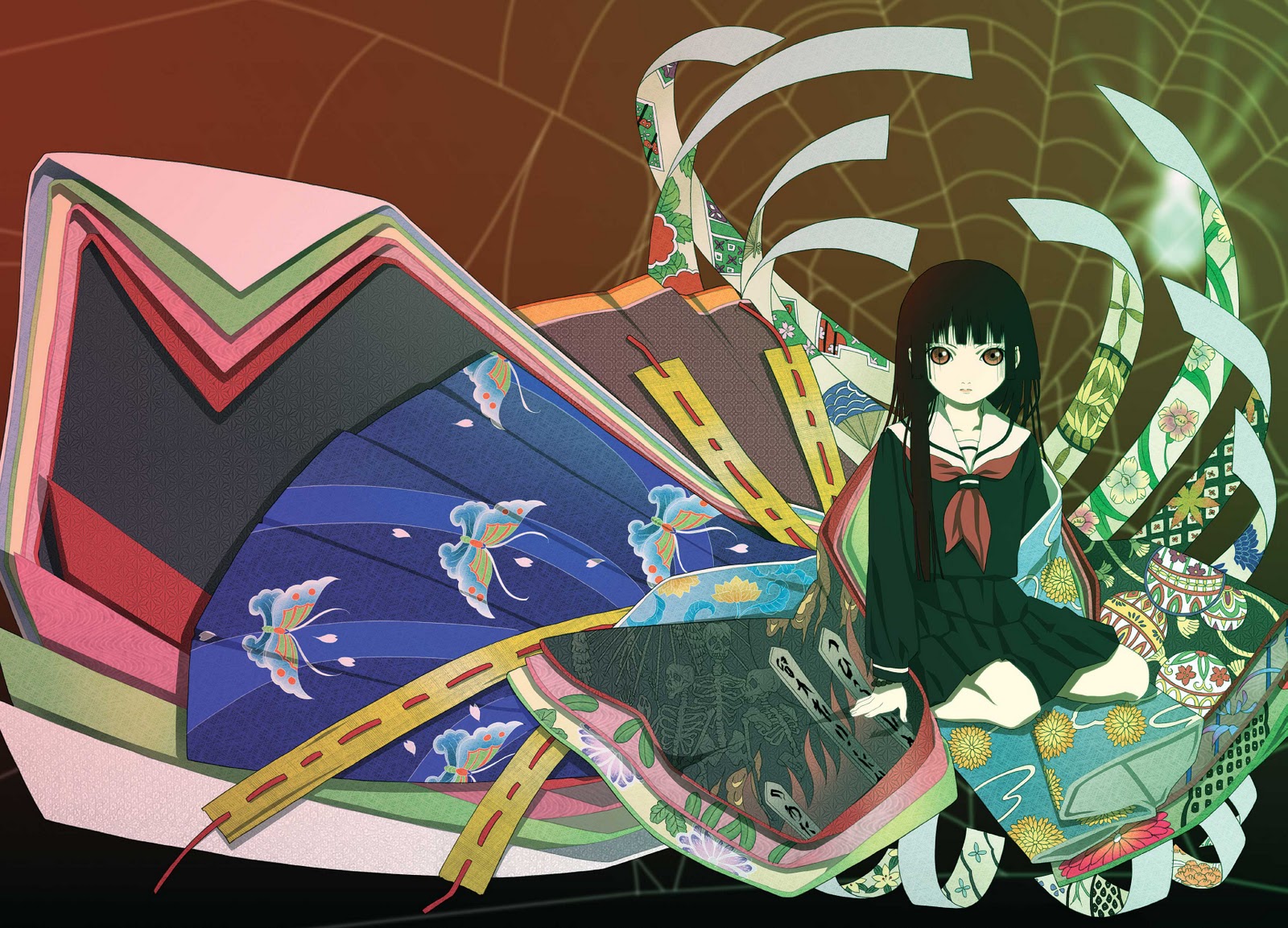
JIGOKU SHOUJO APPRECIATION POST

Hey guys, how are you?
 Today I was thinking about what to post, and I thought about a lot of pop singers/bands (mostly ppl who represented countries on Eurovision this year XD) but I didn't want to talk about them because I'm not listening to pop recently ^-^" and them I remembered this horror/drama/whatever anime/manga/live action that I used to watch and have to start again because it's amazing \o/

 Basically, Jigoku Shoujo (地獄少女), also known as Hell Girl, tells the story of a supernatural website where people can take revenge by having other people sent to Hell via the services of Enma Ai and her assistants. Most of the episodes tells a short story showing the suffering of a random person. When they can't stand anymore, they acess the Hell Correspondence website. Then, Ai gives the person a little straw doll with a red string around it's neck. When the person pulls the string, Enma Ai come to punish the person and, after that, send he/she to hell.
 By the way, initially, people contacted the Hell Girl writing the names of whom they hated on an ema, which later changed to sending a letter to the address appearing in a three-column newspaper advertisement only visible to those with enough hatred.
Each medium can only be used at midnight, and Enma will take the client to a realm of perpetual twilight where she offers them the doll, one of her companions, and describe to the client the details of their contract.However, when the client dies, he or she, too, will go to Hell, and a black crest-shaped mark appears on the client's chest to serve as a permanent reminder of this and their decision to send someone to Hell.


Official website: http://www.jigokushoujo.com/ (in Japanese)


Information from wikipedia, because they kind of put into words what I was thinking ^-^" 
There's a real hotline to hell where you can write a name and all. And it won't take no one to hell, so you can still be happy and go to heaven ^-^ BTW I don't know if a person who desires another one's suffering deserves going to heaven
 I found this swebsite where you can find the episodes, but I didn't started watching yet, but it looks good ^///^


That's it, I hope you like it :3 
I think it's a good anime to think about to, about hating things....we should think more about that since we're always saying "I hate this" and all :S
 Take care o/